Kevin Forsyth Home
Visits since 04-Dec-97

History of the Delta Launch Vehicle


Current Delta News

(What about Delta IV?)

24-Jun-08 | Delta flight 334 — OSTM/Jason-2

For the second time in less than nine days, a Delta II has launched a new science probe for NASA.

This time around it was OSTM/Jason-2; the forgettable, agglomerated name comes from Ocean Surface Topography Mission and the fact that this is a follow-on to the Jason-1 satellite (launched in December 2001 on Delta 289). Jason-2 will continue measurement of global ocean surface topography for at least another three years, and is a joint project of NASA, NOAA, CNES, and EUMETSAT.

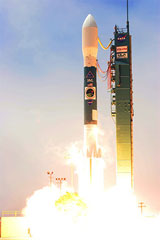
The dead-of-night launch took place early Friday morning, 20 June, at Vandenberg Air Force Base’s SLC-2W and saw a typically uneventful countdown. The mobile service tower was kept in place until first stage fueling was complete, since the wind was gusty early in the evening. This subsided well before the launch window opened and the rocket left the pad at an official range time of 07:46:25.192 UTC.

Just over 55 minutes later, the tracking station at Hartebeesthoek, South Africa, provided an odd combination of ratty data (according to Telemetry Manager Marc Lavigne, welcome back to the mic) — and a perfectly clear engineering camera view as the spacecraft separated from the Delta II second stage and unfurled its solar panels.

This flight marked the 82nd success in a row for the venerable Delta II.


11-Jun-08 | Delta flight 333 — GLAST

NASA’s Gamma-ray Large Area Space Telescope (GLAST) is now in its operational orbit, thanks to a successful launch aboard a Delta II-Heavy today. The Delta II launch record now stands at 81 consecutive successes, an unprecedented testimonial of reliability that began over 11 years ago.

The launch, at first slated for mid-May, was delayed for more than three weeks due to stacking issues with the Delta II launch vehicle. Installation of the second stage was delayed when an H-beam adapter, part of the SLC-17B hoisting system, was fractured during prep work around 5 April. Although the second stage was undamaged, a new H-beam had to be manufactured and tested. Later, a 5 June launch date was postponed when the Delta II’s Flight Termination System battery showed signs of flakiness and was swapped out.

Today there were no major issues with the vehicle or spacecraft, although the tracking station at Antigua went offline for a while, resulting in a 20-minute delay in coming out of the T-minus 4 minutes built-in hold. Although the 115-minute launch window afforded plenty of slack for the extended hold, the weather, partly cloudy and breezy, was threatening to worsen in the early afternoon. Fortunately, no other issues arose and the Delta II-Heavy was able to liftoff at an official range time of 12:05:00.521 EDT.

The two-stage 7920 rocket, the fifth Delta II to use upsized GEM-46 solid motors for extra boost, thundered off the pad and streaked through the scattered cloud deck, passing each of its scheduled flight events with precision. The first and second stage burns totaling about ten-and-a-half minutes were followed by a 55-minute coast phase, and then a fairly brief 64-second burn to circularise the orbit around 300 nautical miles altitude. GLAST was released about 75 minutes after launch while within sight of the Kwajalein tracking station, and shortly thereafter it unfurled its solar panels.

After successfully deploying the spacecraft, the Delta second stage performed a gentle evasion manoeuvre using its helium thrusters, and later completed a pair of additional burns using its primary engine — one for further evasion of the spacecraft, and one to deplete its hypergolic propellants. This final burn left the stage in an elliptical orbit with a 99 nautical mile perigee, which will significantly reduce the time until it reenters the atmosphere and burns up.

GLAST carries the most advanced instrument ever built to study some of the universe’s most dynamic and cataclysmic events — supermassive black holes, merging neutron stars, and other phenomena that produce highly energetic gamma-ray radiation. After a 60-day checkout and calibration period, the $693 million telescope is expected to spend at least five years performing both a full sky survey and in-depth, targeted observations.


25-May-08 | Success!

Phoenix is on Mars!

The lander survived its arduous EDL phase and has transmitted signals confirming its safe arrival on the Martian northern plains. Follow-up subsystem checks have yet to complete, but the nail-biting part is over.

Congratulations to NASA-JPL, the University of Arizona, and all their contractors and contributors!


16-May-08 | On course for Mars

Phoenix is nearing the end of its cruise phase, and will arrive at Mars on Sunday, 25 May. Using a heat shield, parachute, and deceleration thrusters, the EDL (entry, descent, and landing) phase will last about seven minutes and is expected to conclude with a gentle touchdown upon spidery landing gear around 23:53 UTC, Earth received time.

Many museums and planetaria around the United States will host landing parties, allowing visitors to watch live video of mission controllers staring nervously at computer screens, while scientists stand by ready to discuss the mission and answer questions. If landing is successful, Phoenix will then begin a three-month surface operations phase, during which it will explore for water ice in the soil of the Martian north pole. Phoenix was launched aboard Delta 325 on 4 August 2007.


16-May-08 | Next launch

NASA’s Gamma-ray Large Area Space Telescope (GLAST) is now scheduled to launch on 3 June.  The flight was delayed from 16 May due to an unspecified issue that arose during stacking of the Delta II-Heavy’s second stage.


15-Mar-08 | Delta flight 332 — NAVSTAR IIR-19 (M6)

A Delta II 7925 early this morning continued Delta’s record-setting string of successful flights with a satellite for the U.S. Air Force’s Global Positioning System.

The weather at SLC-17A was fairly lousy for much of the evening as the terminal countdown got under way, with overcast skies and intermittent rain causing a brief delay to first stage oxidizer tanking operations. As the count continued, no major issues with the vehicle were worked. For a while the range was no-go for an issue this author believes was a risk of toxic fumes getting blown inland in a self-destruction event, but ultimately this was closed and the only delay was a one-minute COLA period at the opening of the fourteen-minute window.

The standard three-stage Delta II lifted off at 02:10 EDT (06:10 UTC), deploying the NAVSTAR IIR-19 satellite 68 minutes later. As commonly happens, a ratty telemetry signal late in the flight led to a brief delay in the declaration of mission success. Nevertheless, the rocket got the job done, extending Delta’s launch record to 80 successes in a row.

Delta II now has a 133 of 135 success rate, one of the best in the industry. Meanwhile, the NAVSTAR IIR-19 will fire its AKM within the next few days to enter Plane A, Slot 4, where it will replace IIA-15, a fifteen-year-old satellite that has more than doubled its design lifetime; IIA-15 still has some life left in it, and will be moved into a “storage” orbit as an available spare.

IIR-19 is the sixth “modernized” GPS satellite, which is upgraded with two additional encrypted military signals for improved accuracy and resistance to signal jamming, along with an added civilian signal. Two more NAVSTAR IIR(M) launches are scheduled for Delta II before the end of the year, at which time the GPS/Delta era will reach its conclusion. To date, all operational GPS satellites, some 47 including today’s launch, have flown aboard Delta II.


15-Mar-08 | Next launch

The next launch will be in the Delta II-Heavy configuration, the first to fly using the ten-foot-diameter composite payload fairing. It will carry NASA’s GLAST, the Gamma-ray Large Area Space Telescope, from Canaveral’s SLC-17B, the only east coast site that can handle the blast effect of the Heavy’s GEM-46 solid booster motors.

GLAST arrived at the Astrotech payload processing facility on 4 March, where it is receiving final preparations for flight. Its Delta II-Heavy will begin stacking during the week of 17 March. Launch is currently scheduled for 16 May.


15-Feb-08 | Navy to “shoot down” USA 193

The U.S. Navy, “acting on orders from the Bush administration,” will launch a tactical missile from an Aegis cruiser to intercept and destroy the failed USA 193 experimental spy satellite (Delta 322), which is otherwise expected to reenter the atmosphere around mid-March. In so doing, the government hopes to “disperse its load of toxic hydrazine rocket fuel before it can… pose a threat to the public.” The intercept is planned for some time after shuttle Atlantis’ return to earth next week, but before the end of February. (Spaceflight Now, 14-Feb-08)

Although the satellite is very near the edge of the atmosphere and any debris generated by the intercept is expected to reenter within a few weeks, this action still seems highly risky in that it has the potential to deflect small, untrackable (but still deadly at orbital velocity) pieces of debris into higher orbits, where they could remain for a long duration. In addition, despite repeated assurances from the Pentagon spokesman — that eliminating the hydrazine threat is the sole purpose of the interception attempt — many independent observers (this author among them) continue to suspect that the real intent is to destroy highly-classified technology before it has a chance to reach foreign soil intact.


08-Feb-08 | ULA “not backing away from Delta II”

Last week the United Launch Alliance announced a restructuring of the Delta II program, “building upon its unparalleled record of mission success to make it more cost effective in a challenging market.” (ULA Press Release, via Spaceflight Now) Under the leadership of program director Rick Navarro, ULA will strive to remain “at the forefront of the medium-lift market.”

On the surface, the statement is vaguely reassuring with regard to Delta II’s future. However, it addresses few specifics of the restructuring plan, and “remain[ing] positioned to offer high reliability and competitively priced launch products to support the market needs” does not necessarily preclude a mothballing, temporary or otherwise, of America’s premier workhorse for spaceflight.


28-Jan-08 | Reentering spy satellite may have been Delta payload

Numerous news sources (AP via the Washington Post, The New York Times, Observer, Globe and Mail) have reported a U.S. spy satellite that is out of control and is expected to fall back to Earth some time in late-February or early-March. Although the government is not providing specifics on the spacecraft, speculation is pointing toward the National Reconnaissance Office’s L-21, also known as USA 193, which launched aboard Delta 322 in December 2006. L-21 “carried sophisticated cameras to take high-resolution pictures and test equipment intended for use on the broader Future Imagery Architecture (FIA) program”[Reuters] and was delivered into the correct (low altitude, high inclination) orbit by its two-stage 7920 vehicle, but was soon declared a loss due to its failure to communicate with ground control.

Early estimates of its size — “about 20,000 pounds and the size of a bus” — presumed that the satellite is one of the massive Keyhole-class spy birds that were once launched aboard giant Titan-IV rockets. If it is L-21 instead, these figures would be grossly overstated. L-21’s weight was classified “for official use only,” but given the payload capacity of the Delta II it would have been on the order of 4,000 pounds and about the size of a four-door sedan.

Since it cannot be controlled, there is no way of knowing exactly when and where the satellite will reenter the atmosphere. Most news outlets are focusing on the potential of the debris to damage something, or injure someone, both of which carry relatively insignificant odds. Given the highly-classified nature of the satellite — independent observers have been unable to determine even the most basic parameters of it, such as whether it was designed to use solar panels — it may be more pertinent to consider the potential for sensitive technology to fall into the wrong hands.

Another issue that has been raised is the possibility that L-21 might carry a radioisotope thermoelectric generator, or RTG, as its power source. Whether this is the case is unclear: the NRO refuses to confirm or deny; a professional analyst deems it “unlikely,” yet is the same person who overestimated the size of the craft; meanwhile amateur skywatchers have published grainy photographs of L-21 that purport to show a lack of solar panels, implying an alternative power source. Regardless, current RTG design makes the chance of a containment rupture fairly remote, even in the case of a hard landing, and the fuel pellet is in a ceramic form that resists heating and vaporization; the odds of environmental impact are extremely low. (In the case of close contact, the highly corrosive hydrazine thruster fuel poses a greater health risk, and the U.S. military is developing contingency plans to quickly retrieve any debris should L-21 end up on land.)


      Next entries »

Archives

Back to top